Microelectronics as Critical Infrastructure
On the second day of the conference, Dr. Stefan Mengel, Head of the Division for Electronics, Autonomous Driving, and Supercomputing at the BMBF, provided a more detailed explanation of the ministry’s positions and activities. He clearly outlined how the “turning point” and geopolitical shifts are also influencing the BMBF’s policies.
In the past, research policy was primarily industrial policy, aimed at securing and creating jobs in the long term and strengthening Germany’s position in international economic competition. As early as 2018, with the European Commission’s first strategic funding initiative, IPCEI (Important Projects of Common European Interest), microelectronics was recognized as a component of critical infrastructure that is indispensable for the functioning of society. This issue has become even more significant. Today, according to Dr. Mengel, microelectronics is a cornerstone for securing the country’s technological independence, political capacity to act, and thus its sovereignty.
In view of the massive subsidies provided by the U.S. and Asia to their semiconductor industries, creating a counterbalance is only possible at the EU level. To be able to compete in this arena, the BMBF has established the “Microelectronics Research Factory.” It is not a physical factory in the sense of a large, centralized facility, but rather a consortium of eleven Fraunhofer Institutes and two Leibniz Institutes spread across the entire country. Thanks to this structure, Germany’s decentralized research landscape can present a unified front in intra-European competition with the major Belgian and French research institutions CEA-Leti and IMEC. The hope is to secure funding for a pilot line next year under the EU Chips Act.
Skills shortage: University studies have a poor image
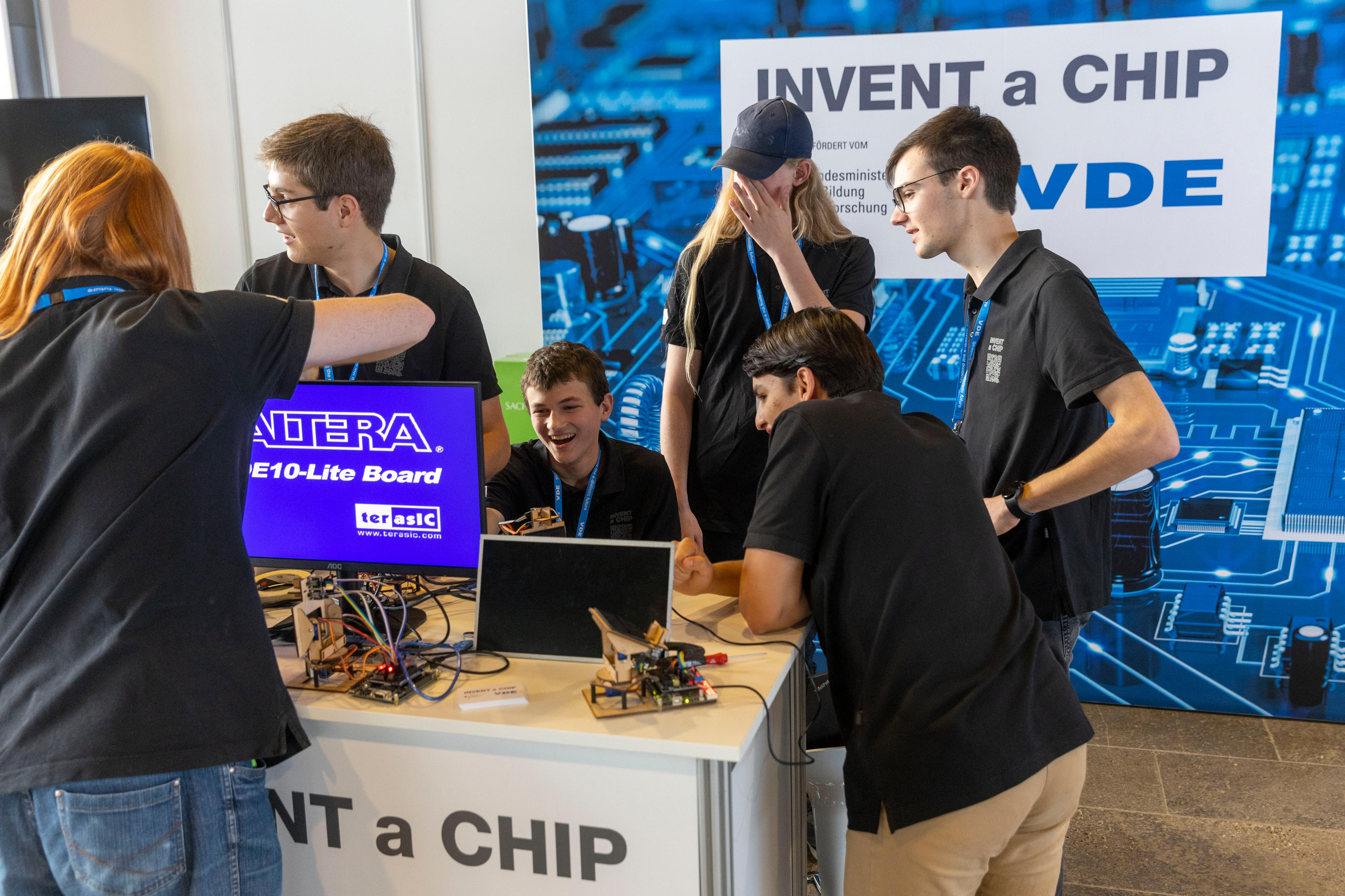
The topic of skilled workers and the next generation of professionals ran through the entire MikroSystemTechnik Kongress and came up again from time to time in keynote speeches and presentations. For the first time, the VDE had included a session entitled ‘New Approaches to Recruitment’ in the programme. During this session, Michael Schanz from the VDE provided a preview of a study on training and the recruitment of young talent, due to be published in December 2023. It reveals that young people with an interest in technology sometimes have completely mistaken ideas about what electrical engineers actually do. A survey of 1,000 participants revealed that the profession of electrical engineer is associated, amongst other things, with laying cables and carrying out installation work. Chip design, sensor technology, the Internet of Things and artificial intelligence, however, were not mentioned. In this regard, Michael Schanz proposed marketing initiatives to improve the image of the engineering profession, particularly on social media. Commenting on the BMBF’s activities, he said that the ministry only promotes STEM subjects in general, meaning that electrical engineering gets lost in the mix, especially as at school, pupils tend to be more interested in IT and computer science. His appeal was therefore directed internally to the VDE, as ‘marketing costs money’.
The study identifies the 65 per cent drop-out rate among electrical engineering students as a major problem. Even first-year students who are good at maths experience a ‘maths shock’ at the start of their degree. They are not told why they will need the material they have learned at a later date. The survey respondents regard ‘staying power’ as the most important quality for success in an electrical engineering degree. This is a slap in the face for the teaching skills of lecturers and the way the degree programme is structured at universities. Schulz: ‘Students extrapolate their initial experience to the entire duration of their studies.’ He suggested introducing practice-oriented modules at an earlier stage and, for example, not having mathematics taught by mathematicians “who indulge in mathematical language and sophisticated proofs”, but rather by engineers in a more practice-oriented manner.
Intensive technical exchange
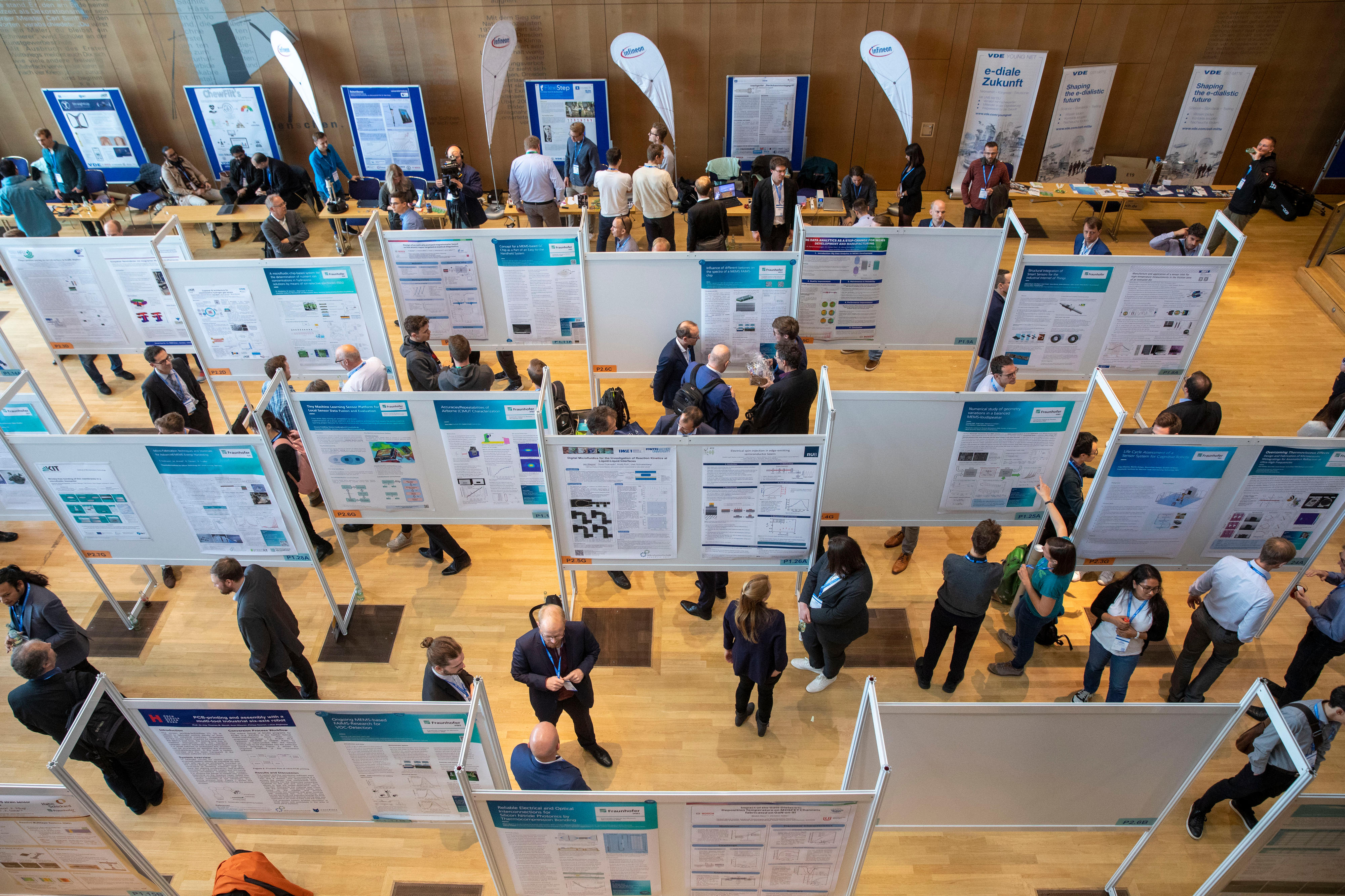
Although this report focuses on industrial policy, the majority of the MikroSystemTechnik Kongress was devoted to technical exchange. The conference centred on sustainability, Green IT and Next Generation Computing. Dr Rutger Wijburg, COO of Infineon, made it clear to the plenary that sustainability and economic growth are not mutually exclusive. Based on various market studies, Infineon expects a seven-fold increase in installed solar capacity worldwide between 2020 and 2030, a four-fold increase in wind power output, an 11-fold increase in annual sales figures for electric cars, and a 3.5-fold increase in the number of IoT-connected devices between 2020 and 2025.
Dr Stefan Finkbeiner, CEO of Bosch Sensortec, provided a fascinating insight into the cutting edge of sensor technology and microactuators. For example, Bosch is working on a projection system for smart glasses that displays information on the lenses, e.g. for navigation or fitness data. Non-invasive, bloodless blood glucose monitoring is another area: bloodless measurement using implants is already possible today. In future, the aim is to do away with even this, which would further simplify the treatment of diabetes. In the field of pressure sensors, Bosch is currently able to detect differences in height in the centimetre range. The capacitive membranes of the gas sensors are so sensitive that – scaled up to the size of a football pitch – they would register a change equivalent to the thickness of two hairs. All of this is manufactured by Bosch exclusively in Germany.